How to Find EU Grants for Startups Without Wasting Weeks on Portals
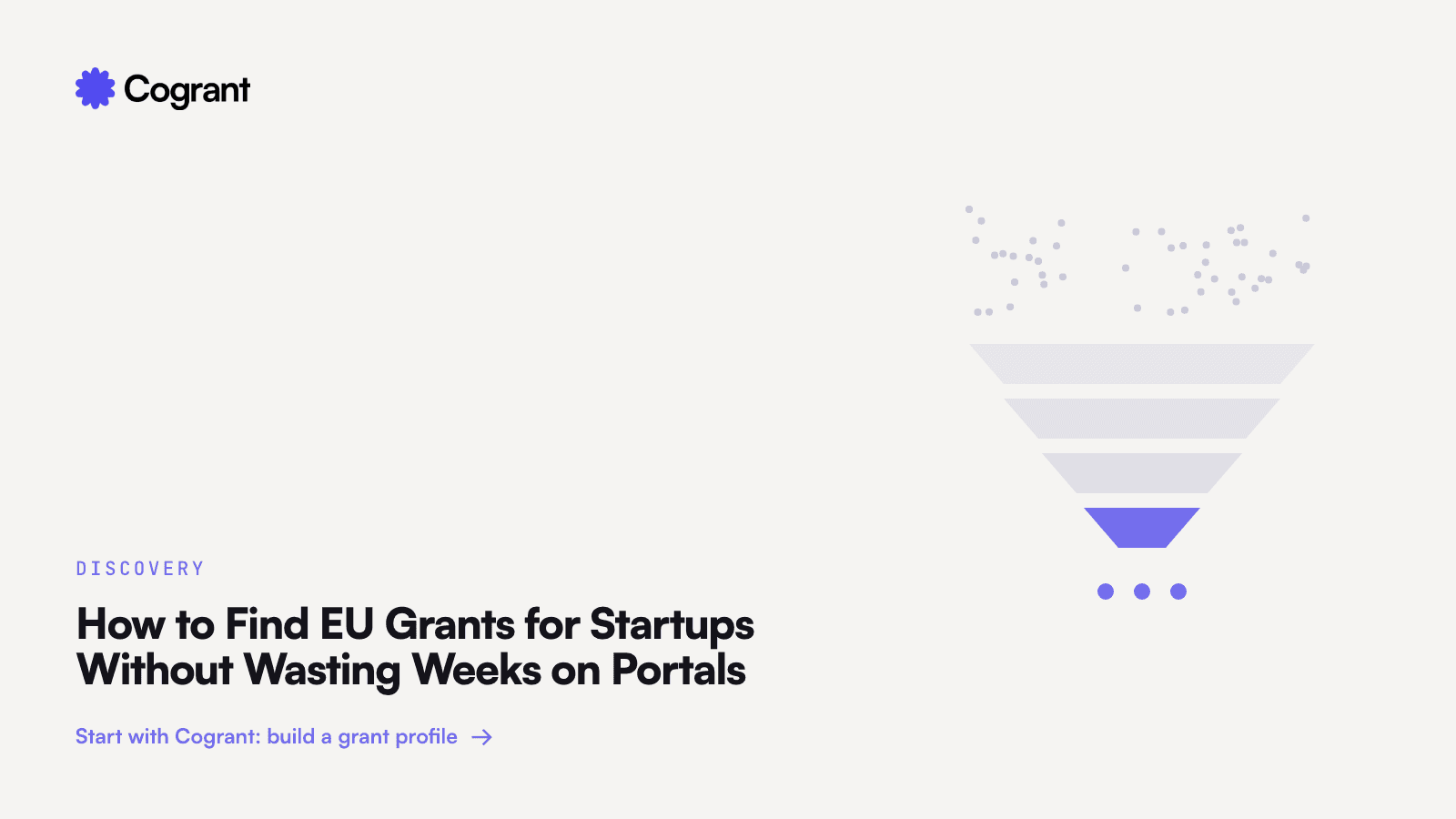
To find EU grants for startups, do not begin with a long list of funding calls. Begin with a funding profile: country, company size, sector, technology readiness level, project type, budget, deadline window and evidence available. Then search only for calls that match those filters.
Quick answer: a startup should look for EU grants through the Funding and Tenders Portal, programme pages such as EIC and Eurostars, national innovation agencies, cascade funding pages and curated grant-matching tools. The goal is not to find every call. It is to find calls where the startup is eligible and competitive.
Why grant search is hard
The problem is not lack of information. The problem is noise. A startup can find hundreds of calls, but most will fail on applicant type, country, project maturity, sector, deadline or budget.
Founders often waste time because they search by broad terms such as “EU funding” or “startup grants” and then read calls that were never realistic for their company.
The five filters that matter
Use these filters before reading full call documents:
Filter | Why it matters |
|---|---|
Country | Many calls depend on EU Member State, associated country, region or national agency |
Applicant type | Startup, SME, research organisation, consortium member and coordinator are different roles |
Sector | AI, health, climate, manufacturing and security calls often have specific policy goals |
TRL | Technology readiness level determines whether a project is too early or too late |
Deadline | A good grant found too late is usually not a good opportunity |
If a call fails one of these filters, do not keep it in the shortlist.
Where startups should search
Source | Use it for | Limitation |
|---|---|---|
EU Funding and Tenders Portal | Central EU calls, Horizon Europe, Digital Europe and other programmes | Powerful but time-consuming |
EIC pages | EIC Accelerator, Pathfinder, Transition and related guidance | Focused on EIC only |
Eurostars | SME-led international R&D projects | Requires consortium and national funding rules |
CORDIS | Research results, projects and programme context | More useful for evidence and market mapping than immediate call discovery |
National agencies | Local and recovery-plan grants | Rules vary by country |
Cogrant Search | Personalised grant matching and shortlist building | Requires a clear company and project profile |
How to avoid irrelevant calls
Remove a call from your shortlist when:
Your company type is not eligible
The country or region is wrong
The topic is adjacent but not central
The required consortium is unrealistic
The deadline does not allow quality preparation
The funding amount is too small for the application effort
The eligible costs do not match your project plan
The discipline is simple: if you need to rewrite the project to make the call fit, it probably does not fit.
When to ask for help
Ask for grant support when the call looks promising but the rules are difficult, the application is strategically important, or the deadline is close enough that wrong prioritisation would be costly.
Grant discovery is not only search. It is interpretation.
Cogrant approach
Cogrant helps companies turn a broad funding search into a focused shortlist. The process starts with company and project fit, then moves into application readiness only when the call is realistic.
What to do next
Start with Cogrant: build a Cogrant Search profile and move from portal browsing to a structured funding shortlist.
FAQ
What is the best place to find EU startup grants?
Start with the EU Funding and Tenders Portal for central EU calls, then check EIC, Eurostars, national agencies and curated matching tools.
Are all EU grants open to startups?
No. Some calls are for SMEs, research organisations, public bodies, consortia or specific sectors.
What is cascade funding?
Cascade funding is EU-backed funding distributed through intermediary projects, often with smaller, more targeted calls for startups and SMEs.
How early should I start looking?
Start at least several weeks before a deadline. Complex EU proposals often need more time.
Should I track every possible call?
No. Track calls that match your company, project and timing. A smaller shortlist is usually better.